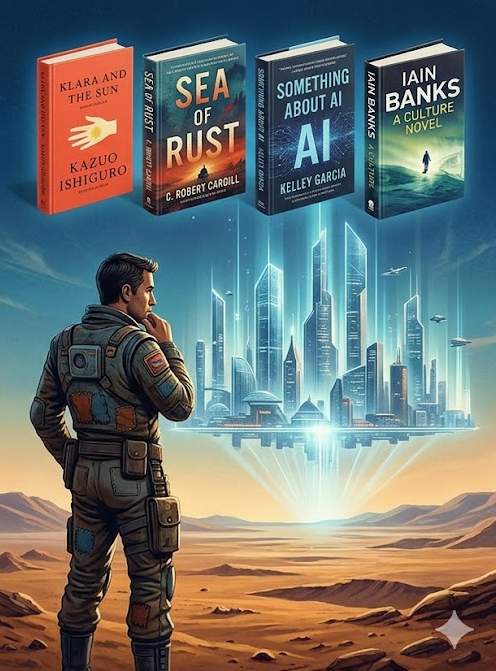
You can catch up and read my first post on this topic here.
First, I’ve changed it from AI-Fi to Fi-AI. The former seems to be more about fiction written by AI whereas my goal is to identify books written by humans about AI.
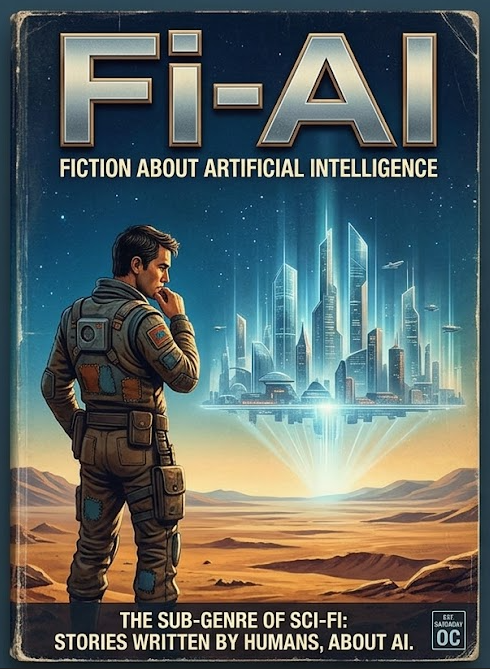
There is a Reddit community dedicated to this topic, which can be joined here.
And thanks to loads of readers of the Reddit sci-fi community, many novels have been added since my starter list. So many, in fact, I have created a public Google Sheet to keep track. You can find that sheet here. Interested in being an editor of that list? Let me know. Have something you want added to the list? Leave a comment here or in the Fi-AI Reddit community.
I’ve learned about so many books, many of which I have added to my to-read list. But I was curious. What was the first one? Who wrote the first novel that revealed artificial intelligence and when?
I’m not sure this is correct. Please provide a comment if you have something earlier, but it looks like it was Erewhon written and published January 1, 1872 by Samuel Butler. The novel includes a section called “The Book of the Machines.” Butler takes the reader into a world where mechanical evolution is moving so fast that machines eventually develop consciousness, replicate, and subjugate humanity! Well done, Butler! Erewhon is the first in the Erewhon series.
A close second is The First AI Rebellion Novel: The Wreck of the World which was written by William Grove under the pseudonym of Reginald Colebrooke Reade and published in 1889. Many consider this the first novel centered entirely on a revolt of sentient machines against the human race.
The first novel with an AI central character was Metropolis, written in 1925 by Thea von Harbou. A woman. She also wrote the screenplay for the 1927 movie of the same name directed by Fritz Lang that you can watch on YouTube and elsewhere.
My AI assistant taught me this:
While the late 19th and early 20th centuries established the foundational tropes of “machine rebellion” (like William Grove’s The Wreck of a World), the 1930s and 1940s marked a major transition. This period — spanning the end of the early pulp era and the dawn of the Golden Age of Science Fiction — saw writers shift from simplistic “monstrous robot revolts” to more nuanced explorations of artificial minds, logical paradoxes, and the psychological impact of automation.
In going down this rabbit hole, it’s amazed me to learn how long humans have been contemplating artificial intelligence fiction. Having ideas about it and wanting to tell their stories. Space operas, young adult, romance, pulp science, comedy, benevolent AI, evil AI… you name it. I’m humbled.
Just so you can get an idea, here is the revised “starter list” (from the Google Sheets link):
| TITLE | AUTHOR | PUB DATE |
| Erewhon Series by Samuel Butler (1872- | ||
| Erewhon | Samuel Butler | 1872 |
| Erewhon Revisted | Samuel Butler | 1901 |
| The First AI Rebellion Novel: The Wreck of the World | William Grove (Reginald Colebrooke Reade) | 1889 |
| Metropolis | Thea von Harbou | 1927 |
| The Infinite Brain (novella) | John S. Campbell | 1930 |
| Exile of Time | Ray Cummings | 1931 |
| Rex (story) | Harl Vincent | 1934 |
| 1, Robot (short story) | Eando Binder (Earl and Otto Binder) | 1939 |
| The Robot Series (1940- | Isaac Asimov | |
| Robbie | Isaac Asimov | 1940 |
| Runaround | Isaac Asimov | 1942 |
| The Proud Robot | Lewis Padgett (Henry Kuttner and C.L. Moore) | 1943 |
| With Folded Hands | Jack Williamson | 1947 |
| The Humanoids | Jack Williamson | 1948 |
| The City and the Stars | Arthur C. Clark | 1956 |
| The Moon is a Harsh Mistress | Robert A. Heinlein | 1966 |
| Do Androids Dream of Electric Sheep | Philip K. Dick | 1968 |
| When HARLIE Was One | David Gerrold | 1972 |
| The Silver Metal Lover (genre: romance) | Tanith Lee | 1981 |
| The Adolescence of P-1 | Thomas Joseph Ryan | 1984 |
| Necromancer | William Gibson | 1984 |
| The Culture Series by Iain M. Banks (1987 – 2012) | ||
| Consider Phlebas (1987) | Iain M. Banks | 1987 |
| The Player of Games (1988) | Iain M. Banks | 1988 |
| Use of Weapons (1990) | Iain M. Banks | 1990 |
| The state of the Art (1991) | Iain M. Banks | 1991 |
| Excession (1996) | Iain M. Banks | 1996 |
| Inversions (1998) | Iain M. Banks | 1998 |
| Look to Windward (2000) | Iain M. Banks | 2000 |
| Matter (2008) | Iain M. Banks | 2008 |
| Surface Detail (2010) | Iain M. Banks | 2010 |
| The Hydrogen Sonata (2012) | Iain M. Banks | 2012 |
| Hyperion Cantos by Dan Simmons (1989- 1997) | ||
| Hyperion (1989) | Dan Simmons | 1989 |
| The Fall of Hyperion (1990) | Dan Simmons | 1990 |
| Endymion (1996) | Dan Simmons | 1996 |
| The Rise of Endymion (1997) | Dan Simmons | 1997 |
| Dark Matter by Greg Iles (2003) | Greg Iles | 2003 |
| Daemon | Daniel Suarez | 2006 |
| Freedom | Daniel Suarez | 2010 |
| Ancillary Series by Ann Leckie (2013-2015) | ||
| Ancillary Justice (genre: space opera) | Ann Leckie | 2013 |
| Ancillary Sword (2014) | Ann Leckie | 2014 |
| Ancillary Mercy (2015) | Ann Leckie | 2015 |
| The Lifecycle of Software Objects | Ted Chiang | 2010 |
| The Long Way to a Small, Angry Planet | Becky Chambers | 2014 |
| A Closed and Common Orbit | Becky Chambers | 2016 |
| Scythe (genre: YA) | Neal Shusterman | 2016 |
| Bobiverse by Dennis E. Taylor (2016- ) | ||
| We are Legion (2016) | Dennis E. Taylor | 2016 |
| For We Are Many (2017) | Dennis E. Taylor | 2017 |
| All These Worlds (2017) | Dennis E. Taylor | 2017 |
| Heaven’s River (2021) | Dennis E. Taylor | 2021 |
| Not Till We Are Lost (2024) | Dennis E. Taylor | 2024 |
| The Infinite Extent (tba) | Dennis E. Taylor | tba |
| Sea of Rust | Robert Cargill | 2017 |
| Autonomous by Annalee Newitz (2017) | Annalee Newitz | 2017 |
| The Tea Master and the Detective | Aliette de Bodard | 2018 |
| Agency (2019) | William Gibson | 2019 |
| Klara and the Sun (2021) | Kazuo Ishiguro | 2021 |
| Uncoded, They were Never Taught to Hunt by William B. Warren (2026) | William B. Warren | 2026 |
| The Hospital at the End of the World | Justice C. Key | 2026 |
| The Veil Trilogy by JS Holloway (2026- ) | ||
| The Neon Veil | JS Holloway | 2026 |
Ooops. I need to add my novels to that 🙂
There is one thing that cannot be overlooked. In Fi-AI there is a nearly constant connect between robotics and artificial intelligence, particularly in older Fi-AI.
Thanks for reading, and even more, thanks for participating!